|
|
|
|
|

2007 Archives |
|
|
|
|
|
|
|
|
|
|
|
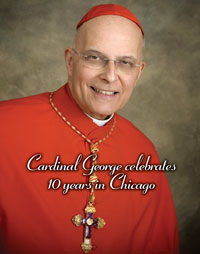 April 29 —May 12, 2007 April 29 —May 12, 2007
As he prepared to celebrate his 10th anniversary as Archbishop of Chicago, Cardinal George sat down at his residence to reflect on his time here. Earlier that day, the Tuesday of Holy Week, he had celebrated the Chrism Mass, the annual liturgy at which sacred oils were consecrated for the coming year. He was heading into a full schedule of liturgies and celebrations during the Triduum and Easter-a schedule unexpectedly cut short when he injured his hip in a fall during the blessing of Easter baskets at St. Ferdinand Parish Holy Saturday.
Decision hinges on settlement, inability to purchase liability insurance
Catholic Charities of the Archdiocese of Chicago has begun dismantling its foster care program after announcing that it will stop providing foster care services as of June 30. The decision, which Catholic and state welfare officials called "tragic," came after Catholic Charities was unable to get liability insurance for its foster care program.
|
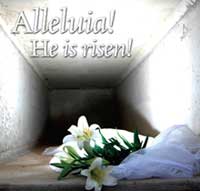 April 15—28, 2007
From darkness to light
Catholics from all corners of the archdiocese made the journey through Holy Week with processions and prayers, starting with memorials of Jesus' triumphant entry into Jerusalem on Palm Sunday. Holy Tuesday brought the annual Chrism Mass, when the holy oils that will be used throughout the year were consecrated, and priests washed the feet of their parishioners on Holy Thursday, in imitation of Jesus' service to his disciples at the Last Supper.
|
 |
April 1—14, 2007
Life lessons
A vocation is not a one-time decision Most vowed religious men and women have a vocation story—a story that explains why and how they decided to commit to a religious life. Agnesian Sister Susan Seeby has two vocation stories. She entered the Felician Sisters in 1985 at the age of 30 and three years ago she began the process of transferring her vows to the Congregation of Sisters of St. Agnes. The transferring of her vows will become official during an April 15 ceremony.
Child abuse prevention month
Parishes and schools all over the Archdiocese of Chicago once again will distribute blue ribbons in April and encourage worshippers and students to think about ways to prevent child abuse and to remember its victims.
 Cardinal George Cardinal George
Church Clips
Interview
Michelle Martin
News & Updates
Obituaries
Parish Pride
|
 |
March 18—31, 2007
Stations of the Cross
In the years of the early church, Christian pilgrims would travel to Jerusalem to walk the Way of the Cross. Now, Catholics around the world retrace the steps of Jesus through the Stations of the Cross in their own churches or communities. Stations of the Cross is a Catholic devotion that has a rich history and can take many different forms.
Since the 4th century, pilgrims would come to the Holy Land and visit places connected to Jesus' life, said Richard McCarron, associate professor of liturgy at Catholic Theological Union. “The pilgrims would come back (to Europe) and recreate these experiences,” McCarron said. By the 5th century, shrines were erected in Europe to that represent some of the shrines in Jerusalem.
Quigley's great goodbye
March 11 was a “bittersweet” day for Archbishop Quigley Preparatory Seminary and its community of faculty, staff, students, alumni and friends, said Father Peter Sneig, the school's president and rector.
The Archdiocese of Chicago's high school seminary will close its doors in June after 102 years of educating young men who are considering the priesthood. On March 11, Quigley hosted “The Great Goodbye” to give everyone an opportunity to visit the school one last time.
Praying for justice for immigrants
It was a cold day with a biting wind when about 30 people gathered on Federal Plaza to raise a cross and pray the rosary for immigrants.
The vigil, sponsored by Priests for Justice for Immigrants, was the first of the six Lenten Wednesday gatherings at which members of the faithful joined the priests in praying for the needs of immigrants and for comprehensive immigration reform.
Cardinal George
Church Clips
Interview
Michelle Martin
News & Updates
Obituaries
Parish Pride
|
 |
Mar. 4, 2007
Faith in higher education?
Colleges and universities offer religious education to Catholics and others
Colleges feed students’ hunger for religious knowledge
Catholic colleges and universities around the United States have become increasingly diverse in recent decades, but that doesn’t mean they take their Catholic identity less seriously.
Making sure Catholic colleges and universities are truly Catholic was the point of “Ex Corde Ecclesiae” (“From the Heart of the Church”). Pope John Paul II’s apostolic constitution on Catholic Universities. Promulgated in 1990, the document was implemented in the United States in 1999.
The document calls on Catholic universities to be faithful to the Christian message while reflecting on human knowledge “in the light of the Catholic faith.”
Catholic universities reach out to other faiths
In a diverse society, Catholic colleges and universities now attract more than just Catholic students. Catholic universities provide support for students from different religious traditions and opportunities for all students to engage in interfaith dialogue.
“Rooted in our Catholic tradition, we have a responsibility and a gift to reach out to our neighbors of other faiths,” explained Javier Orozco, the associate director of religious diversity at DePaul University. He said this interfaith dialogue is especially important in a university atmosphere.
Catholic universities provide practical support for students of other faiths. Usually, the campus ministry offices will offer pastoral support for faith groups on campus, space for students to worship and pray and assistance with planning events.
Cardinal George
Church Clips
Interview
Michelle Martin
News & Updates
Obituaries
Parish Pride
|
 |
Feb. 18, 2007
Ashes to ashes
Lenten season of penance,
preparation begins
Ash Wednesday falls on Feb. 21 this year, and Catholics must consider what sacrifices to make, how to serve others and how to grow closer to God during the season.
Every year, Catholics focus on prayer, fasting and almsgiving during Lent, traditions that have roots in the early Christian church.
The tradition of fasting in preparation for the Easter celebration likely comes from the time of the early church, when catechumens would fast before receiving the sacraments of baptism and Communion, according to Dennis Martin, associate professor of historical theology at Loyola University.
Lenten Remembrance
Byzantine Catholics pray for the dead on All Souls Saturdays
When faithful of the Byzantine Catholic Rite observe Lent, their practices include an increase in fasting, prayer and almsgiving, just as in Roman Catholic communities.
But Byzantine Catholics—who are in full communion with the Roman Catholic Church—add another layer: prayer specifically for the souls of their loved ones who have died.
Bridgeport’s Terabithia
Seated in front of a display of “Bridgeport’s Terabithia,” author Katherine Paterson read first from “Bridge to Terabithia,” the 1978 Newbery Award-winning novel that was released as a Disney film Feb. 16.
Paterson gave whiny Maybelle, desperate but stoic Jess and imaginative Leslie each their own voices, despite suffering from a cold.
Her audience of fourth-, fifth-, and sixth-graders at Bridgeport Catholic Academy listened raptly, before launching a series of questions about how Paterson became a writer and what made her write this particular book.
Cardinal George
Church Clips
Interview
Michelle Martin
News & Updates
Obituaries
Parish Pride
|
 |
Feb. 4, 2007
Feeding the spirit
Volunteers find joy in helping
There are no shortages of opportunities to serve your neighbor in the Archdiocese of Chicago. With hundreds of parishes and schools, organizations that serve the poor, immigrants, disabled people and others, those who want to put their resources to work need only look for an opportunity.
Volunteering … to be holy
“You shall love the Lord your God with all your heart, with all your soul, with all your mind and with all your strength. The second is this: You shall love your neighbor as yourself. There is no commandment greater than these.”
Mk 12:30-31
When Jesus gave his followers the great commandment, he forever bound believers to the community of people around them, and required them to do what they could to help. “Why do we have to serve our neighbor?” said Father Michael Fuller, an instructor in Christian life at the University of St. Mary of the Lake/Mundelein Seminary. “The short answer is because Jesus told us to.”
Pro-lifers march for life here, and in Washington
Catholics from the archdiocese of Chicago made their voices heard on Roe v. Wade Jan. 20-22, the weekend of the 34th annual March for Life.
Many pro-life advocates who could not travel to Washington D.C. gathered the afternoon of Jan. 21 for 12:30 Mass at Holy Name Cathedral, then had their own march to the Water Tower at Michigan and Chicago avenues, where they held a vigil.
Despite competing with the Chicago Bears' NFC Championship game, the event drew about 100 people, according to Emily Hergenrother, one of the organizers. Participants included Knights of Columbus; staff and volunteers from the Women's Center, a crisis pregnancy center; and students from Moody Bible Institute.
Cardinal George
Church Clips
Interview
Michelle Martin
News & Updates
Obituaries
Parish Pride
|
 |
Jan. 21, 2007
New schools growing up
News of Catholic schools closing seems to have dominated the news in recent years, but that’s not the whole story.
Several schools have opened in the Archdiocese of Chicago, serving students from the Northwest suburbs to the South Side of the city, most starting at the youngest grades and adding a year as their oldest classes get older.
The leaders of those schools have some advice for anyone wanting to start a Catholic school: dream big, and believe in what you are doing.
Catholic schools have faith in service
Kathleen Barton, principal of St. Juliana School, is an idea person. She, like many of her Catholic school peers, finds unique ways to combine service along with faith in the classroom.
One of her best, she said, happened when she invited teachers to create individual outreach projects for Advent instead of asking them to participate in one school-wide activity. “We have a very creative staff at St. Juliana, many of whom are involved in social justice projects after school hours,” Barton said. “I thought it would be interesting to see what our teachers could create that would prepare our children for Jesus’ birth and help others in a tangible way.”
|
 |
Jan. 7, 2007
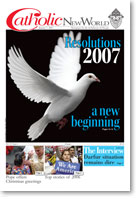
Resolutions 2007: A new beginning
It’s the time of year when health clubs start advertising heavily, trolling for people who in a weak-willed moment will sign a contract to go exercise—and, in many cases, never set foot inside the gym after Jan. 15.
Something about the New Year sparks us to take a look at our lives, re-evaluate and make a commitment to do better, to be better. Some are superficial (how many want to lose 5 pounds?), some are serious and health-related (anyone trying to keep a resolution to quit smoking?), and some are spiritual.
Those are the ones the Catholic New World is most interested in. What will you do to lead more faith-filled life? To make the world better? To improve your relationship with God? How do you want the world to change?
Pope offers Christmas greetings
Celebrating Christmas at the Vatican, Pope Benedict XVI said the world still needs a savior, despite technological advances that make humanity consider itself the “self-sufficient master of its own destiny.”
At Midnight Mass in St. Peter’s Basilica, the pope said the birth of Christ should focus attention on all the suffering and abused children in contemporary society.
Later, in a Christmas Day blessing “urbi et orbi”—to the city of Rome and the world—he said recent developments like space travel, genetic engineering and the Internet only accentuate man’s need for spiritual salvation.
Top stories of 2006
2006: A year of hurt, hope and
healing
Top stories included cardinal’s health, clergy sex abuse, immigration
Catholics in the Archdiocese of Chicago donated more money to the church in 2006, but slightly fewer of them attended Mass.
The faithful kept giving in a year bookended by publicity about allegations of clerical sexual abuse, starting with the arrest of Father Daniel McCormack in February. |
|
|
|
|
|
|