 |
 |
|||||
 |
 |
 |
 |
 |
 |
|
 |
 |
 |
 |
 |
 |
 |
 |
 |
 |
 |
 |
 |
|||
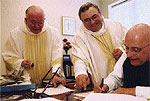 Fathers John Rolek, left, and Patrick Lagges assist Cardinal George in the signing and sealing of documents marking the end of the diocesan inquiry into an alleged miracle attributed to Venerable M. Theresa Dudzik, the founder of the Franciscan Sisters of Chicago. The cardinal marked the closing of that phase of her path toward beatification with a Mass of Thanskgiving June 23. Catholic New World/David V. Kamba |
Closer to sainthood
Mother Theresa Dudzik’s ‘miracle’ proof goes to Rome By Patty Gayes Chicago has moved a step closer to having another “local” saint with the official closing of the inquiry into a miracle attributed to the Venerable M. Theresa Dudzik. Mother Theresa was the founder of the Franciscan Sisters of Chicago, the first religious sisterhood established in the archdiocese. The June 23 celebration at the Franciscan Sisters’ convent in Lemont, where the order is now based, included the final signing of the inquiry followed by a Mass of Thanksgiving. Cardinal George celebrated the liturgy, which was attended by a few of Mother Dudzik’s family who still live in the area. If the Vatican concurs that the evidence shows a miracle occurred, Chicago’s own Mother Theresa will be beatified, the last step before becoming a saint. If she is eventually canonized, Mother Theresa would be the second Chicagoan to become a saint, following Mother Frances Cabrini. “When we celebrate the lives of saints, we don’t just celebrate great heroes of history,” Cardinal George said. “We celebrate God’s grace in their lives. Mother Theresa shows that God’s grace can operate anywhere—even here in Chicago.” Mother Theresa Dudzik immigrated with her family to Chicago from Poland, where she was born in 1860 as Josephine Dudzik. This Polish connection led to the miracle that has been documented in the case for her sainthood, when a Polish mother sought the help of Mother Theresa. In 1972, 54 years after Mother Theresa died, a train wreck at the 27th Street station in Chicago killed 45 people and injured more than 300, including 18-year-old Jerry Lisiecki. The teen was not expected to live and languished in a coma with massive injuries to his head, arms and a leg. Shortly after Christmas, Lisiecki’s mother Roseann, a fellow Pole and devout Catholic, visited the Franciscan Sisters’ convent in Lemont. She prayed for her son before Mother Theresa’s sarcophagus. As she left, she picked five petals from one of the nearby poinsettias. Back at the hospital, she placed the petals on her son. “Roseann Lisiecki claimed that her son, Jerry, was cured shortly after her visit to the sarcophagus,” said Franciscan Sister Anne Marie Knawa in her book “As God Shall Ordain: A History of the Franciscan Sisters of Chicago, 1894-1987.” The cause for Mother Theresa’s canonization, though, started much earlier, in the late 1940s, through the work of the Franciscan Sisters of Chicago. The first step was to “show that the person practices moral, theological, and cardinal virtues to a heroic degree,” said Oblate Father William Woestman, associate vicar for the archdiocesan Office for Canonical Services. Mother Theresa passed this stage in 1994, when she was declared venerable. In the next step, said Woestman, a miracle must be documented to show that there was an actual disease or injury, that prayers were made for the intercession of the venerated, and that there is no scientific explanation for the cure or recovery. The documentation of the miracle is carried out by those pursuing the cause and by their advocate, called a “postulator.” Mother Theresa’s postulator, Andre Ambrosi, left for the Vatican last Wednesday with the evidence supporting a miracle. There the case will receive sharp scrutiny, first by a group of doctors, then by theologians and finally by the Congregation for Saints. If each approve, the final decision will be made by the pope and the Venerable Theresa Dudzik could be beatified. She would then be known as Blessed Theresa. Then, the process of waiting for and confirming a second miracle through her intercession will begin again. This second miracle will lead to canonization. “The miracle does not prove a person is in heaven,” said Woestman, who attended the celebration in Lemont. “The miracle is only an indication of this. Canonization is a legal process to prove something spiritual.” “The process can be very long,” said Franciscan Sister Francine Labus, who has helped with the cause over the past several years. “It’s clearly all in God’s timing.” “I was happy to see this move ahead,” said Father John Rolek, who was at the Mass and has been involved in this cause for sainthood for decades. A member of the archdiocesan tribunal, he is notary for the cause involved in several steps during the process. The subject of the reported miracle, Jerry Lisiecki, died in 1997. His mother was very ill and could not attend the ceremony. For Mother Theresa’s family members, God’s timing has been long in coming. “My grandfather was Mother Theresa’s nephew,” said David Frank, who with his sister Donna Podborny is one of the few remaining relatives. The two brought up the gifts during the Thanksgiving Mass. “My father and my grandfather have both died now, but they would have been so proud to be here. Ever since she died, they knew she would be a saint one day.” Their aunt’s public ministry began a few years after her immigration to Chicago’s “Polish corridor.” In prayer one day, Josephine “was moved to shelter, in her own home, the aged, poor, disabled, and abandoned whom she encountered in her neighborhood,” Knawa said. She did just that, beginning in 1894 the religious community eventually known as the Franciscan Sisters of Chicago, and winning the help of the church in building St. Joseph Home for the Aged and Crippled on Chicago’s Northwest Side. After some early wobbly years, the community and its ministries grew, staffing orphanages, schools, health care and child care facilities and homeless shelters. More than 80 houses and institutions have been staffed by the Congregation of the Franciscan Sisters of Chicago to date. In the preface to “As God Shall Ordain,” Knawa said Mother Theresa Dudzik was present in Chicago’s growth and development, when many needs were created and left unmet. “Mother Theresa sought only to do the will of God,” said Franciscan Sister Diane Marie Collins, the order’s administrator. “We strive to live our lives in this example of faith for the honor and glory of God.”
|
||
|
|
|||