 |
 |
|||||
 |
 |
 |
 |
 |
 |
|
 |
 |
 |
 |
 |
 |
 |
 |
 |
 |
 |
 |
 |
|||
 |
Living the Gospel
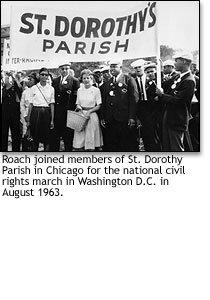
Honors for a social justice pioneer Michelle Martin When Peggy Roach was in high school in the early 1940s, her teachers at St. Scholastica Academy told her about Friendship House, a sort of settlement house on the South Side started by Baroness Catherine de Hueck. Roach wanted to volunteer, but her mother wouldn’t hear of it, not unless she could find someone to go with her. That might have been the last time anyone told Roach she couldn’t go somewhere. Roach, 76, will be honored for her work in civil rights and a plethora of other social justice causes by Amate House, the Archdiocese of Chicago’s year-long service program for young adults. She will receive the organization’s Bernardin Medal at the Amate Magic dinner and reception April 30 at the Grand Ballroom on Navy Pier. “When we say we stand on the shoulders of pioneers, especially in regard to social justice, Peggy Roach is one of those individuals,” said Bill Purcell, director of the archdiocesan Office for Peace and Justice. “She was at the forefront of working for racial justice back when you risked your life to take a lead on the issue. She has been an ever-present champion for the poor and vulnerable. She exudes the Gospel message to love your neighbor.” Perhaps best known in Chicago as the long-time assistant of Msgr. Jack Egan, Roach was a force in her own right, getting involved with causes from housing speculation to scholarships for urban students to predatory payday loans. “We were a good team,” she said of her work with Egan. “We had a complementarity of talents. He had all these ideas, but they never would have come to anything if somebody didn’t nail them down and do them. I’m a get-it-done kind of person.” She also is a one-woman lesson on Catholic social teaching in Chicago—and the value of networking. “I have met so many wonderful people who taught me so much,” she said. “I was being mentored every time I turned around. I really truly believe I’m a very ordinary person who had extraordinary opportunities to help.” Roach, now retired and living with two sisters in Waukegan, is a Chicago original. A graduate of St. Henry School, St. Scholastica High School and Mundelein College—with a major in English and journalism—Roach started her professional life in 1949 as a secretary at the Naval Air Reserve Training Command in Glenview. From there, she held a succession of secretarial jobs, leading to three years as the executive secretary of the Archdiocesan Council of Catholic Women in Chicago, from 1954-57. During that time that she first met Egan when he was attending a meeting near her office. “He walked in and said, ‘My name’s Egan. Can I use your phone?’” Roach recalled. “He was always needing to use your phone.” She never lost the interest in civil rights developed at St. Scholastica and Mundelein College, attending downtown meetings of the Jack Ryan Forum—a kind of lecture group on Catholic social issues. “Whatever the issue of the day was, they would have the right speaker,” she said. “And it was the kind of place where you would meet interesting people.” In 1962, Margaret Mealey, the director of the National Council of Catholic Women, called. She was looking for a staff person to serve as secretary to the council’s social action and legislative committee in Washington, and one of Roach’s many contacts said, “You needs someone like Peggy Roach.” “I ended up in Washington at just the right time for the civil rights movement, 1962-1966,” she said. “Kennedy had just been elected, and everything was going on.” Among Roach’s responsibilities was attending weekly meetings of the National Leadership Conference on Civil Rights, a strategy-making group that included representatives from the NAACP, the Urban League and other civil rights and religious organizations. “We were trying to figure out how to make this happen, and I had a front-row seat,” said Roach, who hosted visiting Catholics from Chicago and around the country, connecting them with Washington people involved in the civil rights movement. She participated with Chicago marchers in the August 1963 march on Washington D.C. when the Rev. Martin Luther King Jr. gave his “I Have a Dream” speech, and she experienced Southern segregation for the first time in 1964 when she went to Jackson, Miss., as part of the “Wednesdays in Mississippi” experience organized by Dorothy Hite and Polly Collins, members of the Black Women’s Leadership Conference to link women from Northern cities with members of their sister organizations in the South. “When we got off the plane, we had to travel in two groups, one with the white women and one with the black women,” Roach said, recalling that the white women stayed in a motel, while the black women stayed with local families. “Every time our van left the hotel, we felt like we were being watched.” And they were: as they left for meetings with civil rights activists and visits to a summer Freedom School, she caught sight of a man noting their license plate number. The atmosphere was tense, following the disappearance of three civil rights workers from nearby Meridian who were later found slain. But when the other visitors went off to visit their counterparts, Roach had no one assigned to her. She remembered that in Chicago civil rights circles, she had heard good things about the young priest who edited the Jackson diocesan paper, a Father Bernard Law, and she decided to pay him a call. Law received her cordially, listened to her story about what the women were doing, and introduced her to Bishop Richard Gerow. There Roach got another lesson in the difficulty of the problem. “He looked at me—he was this tall, thin man. He looked like he should play a bishop in a movie—and he said, ‘Miss Roach, I would give my life to change things,’” she said. “You just got this feeling of helplessness.” Roach returned to her Chicago home in 1966 to help care for her mother, who suffered from Parkinson’s Disease. She renewed her connection with Egan, who had been named pastor of predominantly black Presentation Parish on the West Side, in addition to his duties running the archdiocese’s urban affairs office. To help out, she began typing his correspondence, delivering it when she went to Mass at Presentation on Sundays. During that time, she worked with the National Catholic Conference of Interracial Justice in Chicago, and helped found the Contract Buyers League, to assist mostly black homeowners who were being victimized by property speculators “flipping” neighborhoods. “The neighborhood around Presentation changed from white to black within two years,” she said. “What they would do is buy all the property from the white families cheaply, then jack up the prices for the black families.” After Roach’s mother died in 1970, Egan was invited to the University of Notre Dame. He hired her as a full-time assistant, and they stayed there until Cardinal; Bernardin asked Egan to come home to Chicago to lead the Office for Human Relations and Ecumenism. Roach served as associate director. In 1987, the team moved to DePaul University in Chicago, where Egan directed the Office for Community Affairs and Roach served as his executive assistant. She retired following Egan’s death in 2001. Roach stays active with many of the organizations she and Egan were involved with, with Holy Family Parish in Waukegan and accepting honorary degrees and awards—from Lewis University and Catholic Theological Union in 2001 and 2002, as well as the Via Sapientiae Award from DePaul in 2002. It isn’t quite what she expected from her life, she said, but then, she never put much stock in expectations. “I don’t think I ever said to myself that in two years I want to be here, or in five years I want to be doing this,” Roach said. “I believe the Lord pushes you around where he wants you to be. I’m a big believer in Providence.”
Tickets to the April 30 Amate Magic dinner in the Grand Ballroom at Navy Pier are $150 each. For information: (773) 745-0002.
Front Page | Digest | Cardinal | Interview |
||