 |
 |
|||||
 |
 |
 |
 |
 |
 |
|
 |
 |
 |
 |
 |
 |
 |
 |
 |
 |
 |
 |
 |
|||
 |
WHEN HOME ISN'T SWEET
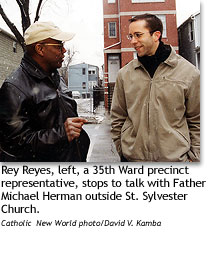
Building homes for whom? St. Sylvester pastor says gentrification drives out community residents When Father Michael Herman wants to show what’s happening to the housing market in the Logan Square neighborhood, he doesn’t have to look far. Right next door to his rectory on Humboldt Boulevard sits The Shakespeare, a 36-unit vintage apartment building. Four years ago, when Herman was assigned to St. Sylvester Parish, the building was run down, and housed many families who used Section 8 subsidy vouchers to help pay the rent. “The backyard was always full of kids,” Herman recalled, adding that many families worshipped at the church and their children participated in youth programs. Now the building has been rehabbed, no children play in the backyard. “There is no backyard,” he said. “It’s all parking.” Then again, as far as Herman has seen, there are no children, either. Instead of a mix of African-American, Hispanic and other families, the building now houses mostly young Anglo professionals, many living with roommates to share the rent. Rents are about double what many of the former tenants used to pay, Herman said. There was no doubt the building needed work. But he said he approached the owner when he found out he intended to rehab about setting aside some of the units for affordable housing, and got no response. Over and over, Herman has heard the same story from parishioners moving out of the neighborhood: We can’t afford to live here any longer. The first new buildings went up in Logan Square before Herman was assigned to St. Sylvester in 2000, and the pace has accelerated since. Developers are rehabbing and driving up housing prices all over the city, but Herman thinks the problem might be worse in Logan Square than anywhere else. “We are the peak,” said Herman. “It’s like trying to stop a snowball rolling down the hill. Sometimes it feels like it’s passed us and we’re trying to catch up to it.” Herman works with clergy, housing activists and community organizers from all over the city on the Balanced Development Coalition, calling for the city to require developers to set aside at least 25 percent of units in developments of 10 units or more for affordable housing—units priced at $150,000 to $180,000, that a middle-class family might be able to buy.
According to the Chicago Rehab Network, Chicago could have gained more than 19,000 affordable housing units over the last 25 years if such a set-aside ordinance had been in place—and the units would be in the areas with the most rapid redevelopment. As it stands, Chicago was the only major U.S. city to gain population but lose rental units during the 1990s, and one out of five renters in Illinois spends more than half his or her income on rent. On March 2, Herman joined about 50 clergy members in a protest at Mayor Richard M. Daley’s office to draw attention to their cause. They received no response that day, and two weeks later, still hadn’t gotten so much as an acknowledgement of the letters they left. Herman has tried other tactics to draw attention to the problem, too, from prayer vigils in front of The Shakespeare to once staging a mock funeral for affordable housing. But walking through the neighborhood, he points out the new three- and four-story split-block condo buildings sandwiched between the older frame and brick houses and two-flats that have made up the neighborhood housing stock for decades. The problem snowballs like this, Herman said: Developers come in and pay huge prices for property, then recoup their costs and make huge profits by putting up condo buildings with units selling upward of $200,000 each, or townhouses at more than $350,000 each. That in turn drives up the value of neighboring properties, bumping tax bills sometimes more than 50 percent in a year. Some single-family homeowners have been forced out by taxes alone, while landlords must raise rents to meet their increased expenses. “It’s not so bad for people who own property and want to move out of the neighborhood,” Herman said, because they can get high prices. “But the renters are out of luck.” Herman understands the attraction of the neighborhood—“We’re a block and a half from the L station,” he said. “I can be downtown to protest at the mayor’s office in 10 minutes.”—but says that the changes are driving out the diversity that makes Logan Square so special. “Right now, we are incredibly diverse,” he said, on a short walk around the neighborhood to point out all the new housing developments. “Racially, ethnically, economically. We have African-Americans, we have Hispanics, we have some of the older immigrants. We have people from all walks of life. And that’s what a neighborhood should be.” That diversity includes the new residents, he said. “We go to great lengths to reach out to them,” he said. “I … do marriage preparation for them. But do they want to hear me talk about affordable housing?” Ironically, he ran into a parishioner, one of the newer residents, on the way to the March 2 protest. She told him the good news—that she and her husband were expecting a baby—and the bad—that they would have to move, because with the added expenses of a child, they could no longer afford the rising taxes and condominium assessments. As a pastor, Herman sees two fundamental problems with the rapid gentrification of neighborhoods. The first is practical: as families move out, often to distant suburbs like Plainfield and Bolingbrook where housing costs less, and young adults move in, the parish loses some of its base. But since many parishioners move to areas that don’t have the services they need—for example, Mass in Spanish—many of the old parishioners come back to worship. “You become a commuter parish,” he said. “That means I can’t really do anything on the blocks, like starting small faith communities, because so many of the parishioners live somewhere else. It’s a totally different way of being a parish.” On a deeper level, it goes against the whole Christian preferential option for the poor, he said. The only way to change it in Chicago is to follow the lead of Boston, Denver, Sacramento, Calif., and other cities that have set-aside laws, Herman said. While Daley has started some voluntary set-aside programs, they have not yielded many affordable units, and as one developer once told him, “We’re basically greedy people.” “That’s why the city has to step in,” Herman said, noting that the cities that do require developers to set aside affordable units are still seeing significant development, “It won’t stop the building. … I don’t think expensive housing is the way to improve the city. How much diversity is going to be left if everything from downtown on out is all upper-income?” |
||
|
|
|||