 |
 |
|||||
 |
 |
 |
 |
 |
 |
|
 |
 |
 |
 |
 |
 |
 |
 |
 |
 |
 |
 |
 |
|||
 |
Body and soul
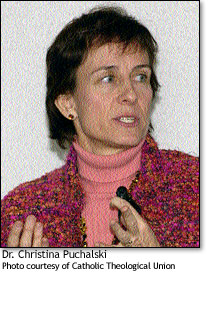
Health links of ‘divine-human interface’ affirmed By Michelle Martin The health of the human body and the health of the human spirit are inextricably linked, and those who work with either must consider the effect on both, according to medical and theological experts who spoke at a Catholic Theological Union conference Jan. 30-31. Health care professionals have come to see the link more and more in recent years, said Dr. Christina Puchalski, founder and director of the George Washington University Institute for Spirituality and Health. Puchalski offered the first keynote address at “The Biology of Spirit: Spirituality and the Science of Healing,” a conference sponsored by the Bernardin Center at CTU. Speaking to an audience that included doctors, nurses, chaplains and medical and theological students, Puchalski called for a greater role for chaplains and said doctors have greater understanding they must recognize a patient’s spiritual needs in order to help healing. From 1993 to 2002, the number of medical schools responding to a survey from her institute that offer courses in spirituality and health care have increased from three out of 125 to more than 90. Unlike most medical trends, increased attention to the interaction between spirituality and health is not based on scientific studies, Puchalski said. “It’s not evidence-based, but based on the ethical obligation to treat whole people,” she said. “It’s important to patients. We didn’t really need data to support that. It just made good sense.” Indeed, Puchalski cast doubt on whether recent studies attempting to measure the effect being prayed for has on patient health have any value. “Some of us feel it’s really impossible to measure the divine-human interface,” Puchalski said. “Essentially, you’re saying if the patient doesn’t get better, it didn’t work. But nowhere in the Lord’s Prayer does it say, ‘my will be done.’ It’s ‘thy will.’” Benedictine Father James Wiseman, former chairman of the theology department at Catholic University of America and author of “Theology and Modern Science,” offered a counterpoint. In “Health for Your Flesh and Vigor for Your Bones: Theological Perspectives on Spirituality and Health,” Wiseman noted that nearly all religious traditions see good health as a great blessing to be enjoyed. Understanding healing, the speakers said, means understanding the difference between the Western medical model of “curing” illness and helping a person find healing, even when approaching death. “Healing is the integration of self,” Puchalski said. “People move from a sense of brokenness to a sense of wholeness.” Surveys and studies have shown that a variety of spiritual practices and attitudes can affect a patient’s own health, especially the sense of healing, she said. “Illness challenges all of us,” she said. “It’s like a fork in the road. Spirituality may be a dynamic in how people understand illness, and it may affect their decision-making.” For example, many HIV-positive patients report feeling that their life is better and has more meaning after being diagnosed. That attitude is stronger among patients who report an active spiritual life, though not necessarily through participation in organized religion. “Spirituality affects how patients and health care providers perceive health and illness and how they interact with one another. It’s not just about our patients’ spirituality, it’s about our own,” she said. Spirituality can have negative effects, Puchalski said. While turning to spiritual practices can help some people find meaning in their suffering or help them cope with the stress of health-related problems, others might feel shame or guilt, or that God is punishing them for some reason. Others might become angry if they pray for a cure that doesn’t come, she said. And people recognized as holy—including many honored on the calendar of saints—have broken their own health even as they acknowledged the goodness of helping others in times of illness, Wiseman said. The New Testament speaks of the human body as something sacred, the “temple of the Holy Spirit,” he said, so “one would expect Christians to take good care of the temples that are their bodies.” But Christians have often bought into the idea of a duality between the body and soul, an idea going back to Plato, who saw the body as a distraction from life on the ideal plane. Saints who practiced gruesome “mortifcations of the flesh”—wearing an iron crown of thorns, like St. Rose of Lima, for example, or bearing a spiked cross—also were attempting to join in the suffering of Christ on the cross, Wiseman said. “Even in cases of love between two human beings, the lover strives to feel in some way identified with the beloved,” he said. But such saints were not looking at the totality of salvation; Christ did not redeem us only by suffering and dying, but also by being resurrected. “Christ’s suffering is not what redeemed us,” Wiseman said. “What mattered was the spirit with which he underwent suffering. On Calvary, Jesus returns love for hate, and makes God’s love present for history and opens a channel for grace. His suffering and death cannot be understood without being raised to new life.” Some Western physicians still cannot understand the importance of spiritual suffering, Puchalski said, because they don’t know how to alleviate it. “Western medicine is based on a fix-it model. Spiritual suffering is all about uncertainty,” she said. But more doctors are willing to address spiritual issues, even with patients who might not be suffering from a serious illness. For example, some incorporate questions about a patient’s spiritual beliefs and the role spirituality plays in their lives when they take a medical history. They also need to look for non-verbal cues, whether it be a cross around a patient’s neck or a copy of the Koran by the bedside, she said. Wiseman agreed, adding that by doing so, they would following the model of “Jesus the Physician,” a title given by St. Augustine “Medicine owes its greatest debt to not to Hippocrates but to Jesus,” Wiseman contended. “Without his spirit, medicine degenerates into depersonalized methodological system and its ethical code into just a legal system. Jesus brings to systems and codes the addition of love. … “Jesus healed primarily because he cared about people. He was filled with compassion for those who were suffering.” Front Page | Digest | Cardinal | Interview |
||