 |
 |
|||||
 |
 |
 |
 |
 |
 |
|
 |
 |
 |
 |
 |
 |
 |
 |
 |
 |
 |
 |
 |
|||
 |
Audit finds most dioceses complying with charter
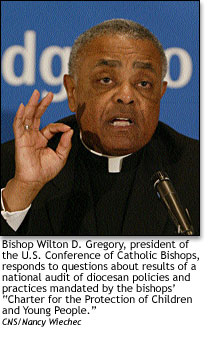
By Jerry Filteau Washington — By the end of 2003, nearly 90 percent of U.S. Catholic dioceses were in compliance with the bishops’ national policy to protect children and respond to clergy sexual abuse of minors, according to the first national audit report released Jan. 6. On most elements, the report said, 98 percent to 100 percent of audited dioceses were judged to be in compliance with the 17-article “Charter for the Protection of Children and Young People” adopted by the bishops in June 2002. There were only two mandates on which compliance was lower than 98 percent: having comprehensive safe environment programs in place throughout the diocese (91 percent) and conducting background checks on all church employees and volunteers who work with minors (93 percent). Most of the dioceses not in compliance were under instructions to make changes in two or more areas. Bishop Wilton D. Gregory of Belleville, Ill., president of the U.S. Conference of Catholic Bishops, said the report “indicates that the Catholic dioceses and eparchies (Eastern-rite dioceses) of the United States have put a tremendous effort into making the charter very much a part of the life of the church since the (June 2002) Dallas meeting.” He noted in an introduction to the report that the audit process also uncovered areas not foreseen in Dallas. “And so the report contains valuable general recommendations for further strengthening the church’s response to the sexual abuse crisis in all its dimensions,” he said. In the initial on-site audits, conducted by the Boston-based Gavin Group between June and November, a little more than one-fourth of dioceses were in full compliance on everything. Another two-fifths were basically in compliance but received one or more recommendations to improve their policies or practices in certain areas. About one-third were given instructions on changes they needed to make in order to come into compliance with the 2002 charter. Many of those that received instructions on some elements of the charter received recommendations to improve their policies or practices in other areas as well. The report said recommendations were given instead of instructions when implementation of a particular article was “incomplete” or when “significant improvement” could be made by an additional or changed procedure. The report also noted that many dioceses received commendations for the quality of their programs prior to adoption of the charter or for notable actions such as “exemplary pastoral outreach and candid, educational communications.” Of the 191 dioceses audited, 129, or 68 percent, received one or more commendations. By the time follow-up reports on audit compliance—and, in three cases, re-audits—were completed near the end of 2003, only 20 of the dioceses that received instructions had not yet taken remedial action to correct their noncompliance in those areas. An additional 14 had not yet implemented recommendations for improvement in one or more areas. The recommendations meant the diocese was basically in compliance with the charter but could do a better job by making some changes in certain areas. Any corrective actions taken or reported after Dec. 12, 2003, missed the deadline for inclusion in the report. Of the 195 U.S. dioceses and eparchies, 191 were audited. The report says the Diocese of St. Thomas, Virgin Islands, and the Armenian Catholic Exarchate of U.S.A. and Canada were not audited due to scheduling difficulties, but they are scheduled for audits this year. The Diocese of Davenport, Iowa, was “cooperative,” but the nature of current litigation it faced led the auditor and bishop to agree “that a full and fair review could not be completed without interference from outside entities,” the report said. The California-based Chaldean Eparchy of St. Peter the Apostle, just formed in July 2002, was not included in the first round of audits. The report also noted that three Latin-rite and three Eastern-rite dioceses did not participate in the nationwide survey by the John Jay College of Criminal Justice on the nature and scope of clergy sexual abuse of minors in the last 50 years. A report on the John Jay survey is scheduled for release in late February. Those not participating in the John Jay survey were the dioceses of Davenport, Iowa; Fresno, Calif.; Lincoln, Neb.; Newton, Mass. (Melkite); Our Lady of Deliverance in New Jersey (Syriac); and St. Maron of Brooklyn, N.Y. (Maronite). In the audit report, two areas proved particularly difficult for dioceses to comply fully with charter requirements: implementation of safe environment programs across the diocese, and full background checks on all diocesan employees and volunteers who work with minors. A complete safe environment program would include training sessions for all church employees and volunteers on the church’s abuse policies, appropriate boundaries to maintain in dealing with minors, and how to recognize and report signs of possible sexual abuse. It would also include parish-based education on sexual abuse for parents and other adults and age-appropriate education for children and youth on recognizing improper conduct and reporting it. Twenty-eight dioceses received instructions on safe environment programs, indicating that what they had in place so far was inadequate, and 47 received recommendations for further improvement. Thirty-two dioceses received instructions on implementing the charter’s requirement of background checks for all church employees and volunteers who work with minors; 39 received recommendations for improvement in that area. Excluding dioceses that subsequently reached compliance, however, by the time of the final report only 9 percent of dioceses were not in compliance on safe environment programs. Only 7 percent were still not in compliance in the area of background checks on employees and volunteers. William A. Gavin, president of the Gavin Group, said the audit was initially a source of concern to many bishops, but it “turned out to be extremely helpful in demonstrating some deficiencies that were not yet known to them. It provided best practices from bishops and eparchs of other dioceses and perhaps introduced diocesan and eparchial leaders to new ways and methods of achieving results.” Front Page | Digest | Cardinal | Interview |
||