 |
 |
|||||
 |
 |
 |
 |
 |
 |
|
 |
 |
 |
 |
 |
 |
 |
 |
 |
 |
 |
 |
 |
|||
 |
Local year in review
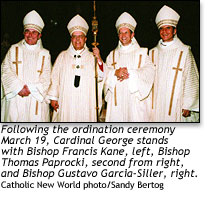
Challenge and change marked 2003 in the Archdiocese of Chicago, as area Catholics bade farewell to three retiring bishops and welcomed three new ones, gathered for the first Festival of Faith, adapted to changes in the way Mass is celebrated, continued to work for social justice on a variety of fronts and confronted financial predicaments and the ongoing crisis created by the scandal of priests sexually abusing children. Archdiocesan Chancellor Jimmy Lago released a report Jan. 16 detailing the sexual abuse cases the archdiocese had learned about from 1992 through 2002—a total of 55 credible allegations of abuse involving 36 archdiocesan priests. None of the incidents occurred after 1991. The report mirrored the report Cardinal Bernardin released in 1992, which included allegations from the previous 40 years against 34 priests. Some nine or 10 of them had allegations against them included in the Lago report as well. According to the report, the archdiocese paid $16.8 million over the 10 years it covered, with the money going towards victim assistance, settlements, treatment and monitoring of priests and legal expenses. Funds came from the sale of undeveloped property, insurance and the unrestricted general fund of the Pastoral Center, which comes from sources such as lease payments, investment income and proceeds from the sale of assets. Cardinal George assured parishioners that no donation, to a parish or the archdiocese, would be used to pay direct expenses related to sexual abuse. Those expenses continue to mount. In fiscal 2003, the archdiocese paid 2.7 million to settle sexual abuse claims, and it has already paid $14.9 million in fiscal 2004, Lago said in a letter accompanying the annual financial report. As those settlements became public, so did more details about the abuse that occurred and the process the archdiocese used to work with the victims. Victims’ attorney Jeffrey Anderson, who worked through a mediation process with the archdiocese on behalf of several clients, praised officials for their openness. (See story, Page 1) Meanwhile, archdiocesan officials continued to comply with Charter for the Protection of Children and Young People, answering a survey about sexual abuse incidents in the archdiocese and undergoing a two-week audit over the summer to make sure the charter was being followed. By fall, between 30,000 and 40,000 staff members and volunteers—including those working in parishes, schools and agencies such as Catholic Charities—were attending training sessions on how to safeguard children from sexual predators. Three new auxiliary bishops are helping lead the church through the scandal. The three—two Chicago natives and a missionary priest from Mexico—were announced in January and installed during a three–hour liturgy March 19. Bishop Francis J. Kane, 61; Bishop Thomas Paprocki, 51; and Bishop Gustavo Garcia-Siller, 47, were called to the episcopacy, replacing the retiring Bishop Raymond Goedert, former vicar general of the archdiocese; Bishop Thad Jakubowski; and Bishop John Gorman. (See stories, Page 12) On the same day the bishops were ordained, the United States started a long-expected war with Iraq. While the initial military phase ended within a few weeks, ongoing small-scale violence continued to take soldiers’ and Iraqis’ lives throughout the year. Even before the war began, area Catholics were participating in prayer vigils and protests for peace, as well praying for the protection of military men and women. Those prayers also continued throughout the year, with several parishes and schools developing ongoing relationships with some servicemen and women and sending care packages and letters, along with their prayers and good wishes. Social justice efforts revolved around a number of efforts, from affordable housing here in Chicago to the AIDS crisis in Africa. None had a higher profile than the rights of immigrants, especially undocumented workers. Many immigrant groups, especially those from Arab or Muslim countries, felt they were under attack from the provisions of the Patriot Act and other government action after the Sept. 11 bombings. Undocumented immigrants from Mexico and Central America also felt the pinch, as what had looked like a promise of cooperation between the United States and Mexico evaporated. But there were victories: In Illinois, undocumented high school graduates who completed at least three years of their high school education in the state now are eligible for resident tuition rates at state universities, and efforts to allow undocumented immigrants to obtain Illinois drivers licenses nearly passed the legislature. In February, pro-life leaders celebrated an 8-1 decission by the U.S. Supreme Court that Jospeh Scheidler and his Pro-Life Action League could not be sued by the National Organization for Women under the racketeering laws. The case, which drew a coalition of activist groups from the right and the left in Scheidler’s defense, ended a 17-year legal battle. Towards the end of the year, Catholics started to become accustomed to minor changes in the liturgy, called for in the General Instruction of the Roman Missal, which went into effect Nov. 30. The general instruction, part of the new edition of the Roman Missal approved by the Vatican in its Latin version three years ago, calls on Catholics to bow before receiving the Eucharist as a sign of reverence and to kneel for the entire eucharistic prayer, among other things. In general, it asks participants to demonstrate reverence for the sacrament and unity as the Body of Christ, according to Belleville Bishop Wilton Gregory, president of the U.S. Conference of Catholic Bishops, who spoke about the changes at Holy Name Cathedral in December. The year drew to a close on a note of celebration, as more than 19,000 people made their way to Navy Pier over four days at the end of October and beginning of November to celebrate their faith in a very public way. The first-ever Catholic Festival of Faith aimed to show Catholics and all of society the breadth and depth of the archdiocese: diverse ethnicities and races, different socio-economic strata, different ways of expressing faith, from liturgy to working for social justice to the arts, but all valid parts of one faith and one church. Front Page | Digest | Cardinal | Interview |
||